

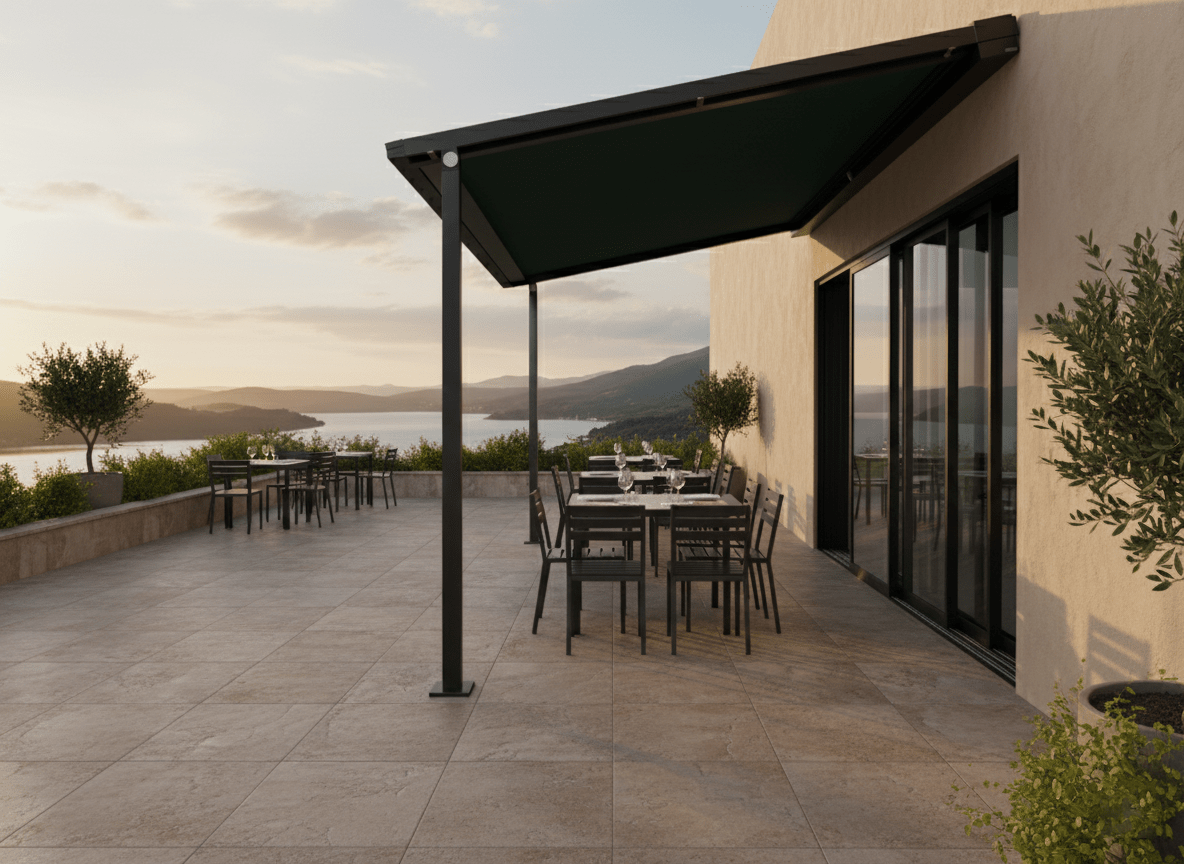
Overview
Australia’s climate diversity — high UV and humidity in Queensland, coastal wind and salt exposure in New South Wales, four-season variability in Victoria, and hot dry summers in Western Australia — makes pergolas and awnings essential components of outdoor living design. This guide covers common product types, materials suited to Australian conditions, permitting guidance tied to the National Construction Code (NCC) and state planning rules, bushfire/BAL considerations, and approximate cost ranges for both residential (To C) and developer / builder (To B) projects.
Regulatory & Permit Guidance (NCC + State / Local)

Key point: There is no single national “pergola permit” rule — pergola and awning works must be checked against the National Construction Code (NCC) and the relevant state / local council rules to determine whether approvals or building permits are required.
Useful official references:
- National Construction Code (NCC) — Australian Building Codes Board (ABCB) — the national technical framework used by certifiers and councils.
- NSW Planning Portal — Exempt Development: Balconies, decks, patios, pergolas — guidance and fact-sheets for NSW exempt development.
- Victorian Building Authority (VBA) — pergolas, verandahs and when a building permit is required.
- Queensland guidance — when building approval is not required (check local council rules for specifics).
Practical advice: always check the local council fact-sheet and consult a private certifier or engineer if your pergola attaches to the house, exceeds local size/height limits, or includes a fixed roof or services.
Bushfire (BAL) Considerations

If your site is in a bushfire-prone area you must obtain a Bushfire Attack Level (BAL) assessment and comply with the relevant standards for that BAL rating. Pergola and awning designs, materials and the method of attachment will be affected by the BAL level. See the CSIRO BAL guidance and the NCC bushfire verification methods handbook for practitioner-level requirements.
- CSIRO — BAL assessment and bushfire guidance
- ABCB — NCC Bushfire Verification Methods Handbook
- Relevant standard: AS 3959 — Construction of buildings in bushfire-prone areas (refer to the current edition when designing in BAL zones).
Materials & Climate Fit
Choose materials according to local climate and exposure:
| Material | Where it works best | Notes |
|---|---|---|
| Aluminium | Queensland, NSW coast, WA | Low maintenance, corrosion-resistant when powder coated; good for high UV & salt environments. |
| Treated Timber / Hardwood | Victoria, southern states | Good aesthetic; requires regular maintenance and termite/rot protection (use H3/H4 treated or hardwoods like Spotted Gum/Blackbutt). |
| Steel (galvanised / hot-dip) | High wind areas, commercial | High strength; must be galvanised + powder coated for coastal durability. |
Product Types
Pergolas

Fixed-roof pergola: provides full rain protection and year-round use.
Louvre (adjustable) pergola: allows control of light and ventilation (may require approvals depending on roof type).
Open timber pergola: aesthetic and popular in temperate areas; higher maintenance required.
Awnings

Retractable awning — flexible shading that can be extended or retracted as needed; widely used for balconies, patios and café seating.

Drop arm awning — angled drop for low-sun protection (east / west facing facades); good for heat control and privacy.

Free-standing awning system — independent shade structure for poolside, garden lounges or commercial courtyards; does not attach to the main building.
Pricing Guidance (Approximate ranges) — Residential (To C) vs Developers / Builders (To B)
Residential homeowners — To C (approximate)

These ranges are indicative only and depend on size, site complexity, materials and any required engineering or council approvals.
| Product | Typical range (AUD) |
|---|---|
| Small fixed-roof pergola (e.g. ~3m × 3m) | From a few thousand AUD |
| Louvre (adjustable) pergola | Often 10,000+ AUD (mid-high range) |
| Retractable awning | Mid to high range depending on size & automation |
| Drop arm awning | More budget-friendly (entry-level prices) |
| Free-standing awning | Higher cost depending on structure & anchoring |
Note: final residential cost depends on site access, ground preparation, footings, electrical work (for motorised systems), and choice of fabric/finish.
Developers & builders — To B (approximate)

For townhouse, apartment, or estate projects — pricing is driven by volume, engineering, façade integration and compliance documentation.
Typical project budgets can range widely depending on scale:
- Small multi-dwelling façade sunshade or pergola package: tens of thousands AUD
- Large integrated façade + courtyard shading across multiple lots or an apartment block: can run to hundreds of thousands AUD
Developers usually procure through staged quotations that include engineering checks, shop drawings, corrosion treatment schedules and installation warranties.
Proline — Custom Pergola & Awning Services for Australia

Proline provides end-to-end custom aluminium, steel and mixed-material shading systems tailored for Australian climates and regulations. Services include:
- Custom design, shop drawings and engineering for wind loads and BAL requirements
- Powder coating and corrosion protection suitable for coastal environments
- Automation options (motorised louvres / retractable awnings) with electrical integration
- Bulk supply and installation packages for developers & builders (To B) and single-site custom installs for homeowners (To C)
Best Practice & Maintenance
Aluminium: rinse salt and debris regularly in coastal areas, inspect powder coat and fixings annually.
Timber: re-seal / stain every 12–24 months depending on exposure; use termite-rated timbers where required.
Steel: check galvanising and repaint as required; consider sacrificial anodes or additional coatings in severe coastal locations.
State / Local Practical Notes
- NSW: check the NSW Planning Portal exempt development pages and associated fact-sheets before starting work.
- VIC: consult the Victorian Building Authority guidance and your local council for building permit requirements.
- QLD: see Queensland’s guidance on when building approval is not needed and check the Building Regulation 2021 and local council rules.
References & Official Resources


Leave a comment
This site is protected by hCaptcha and the hCaptcha Privacy Policy and Terms of Service apply.